
OBU’s Vision for the Future Through Innovation, Industry Collaboration and Faith
OBU’s academic programs thrive on deep partnerships with business and industry to ensure their continued relevance and to prepare students for today’s workforce. The university’s new engineering program is no exception, benefiting from strong industry connections and the unwavering support of alumni and donors.
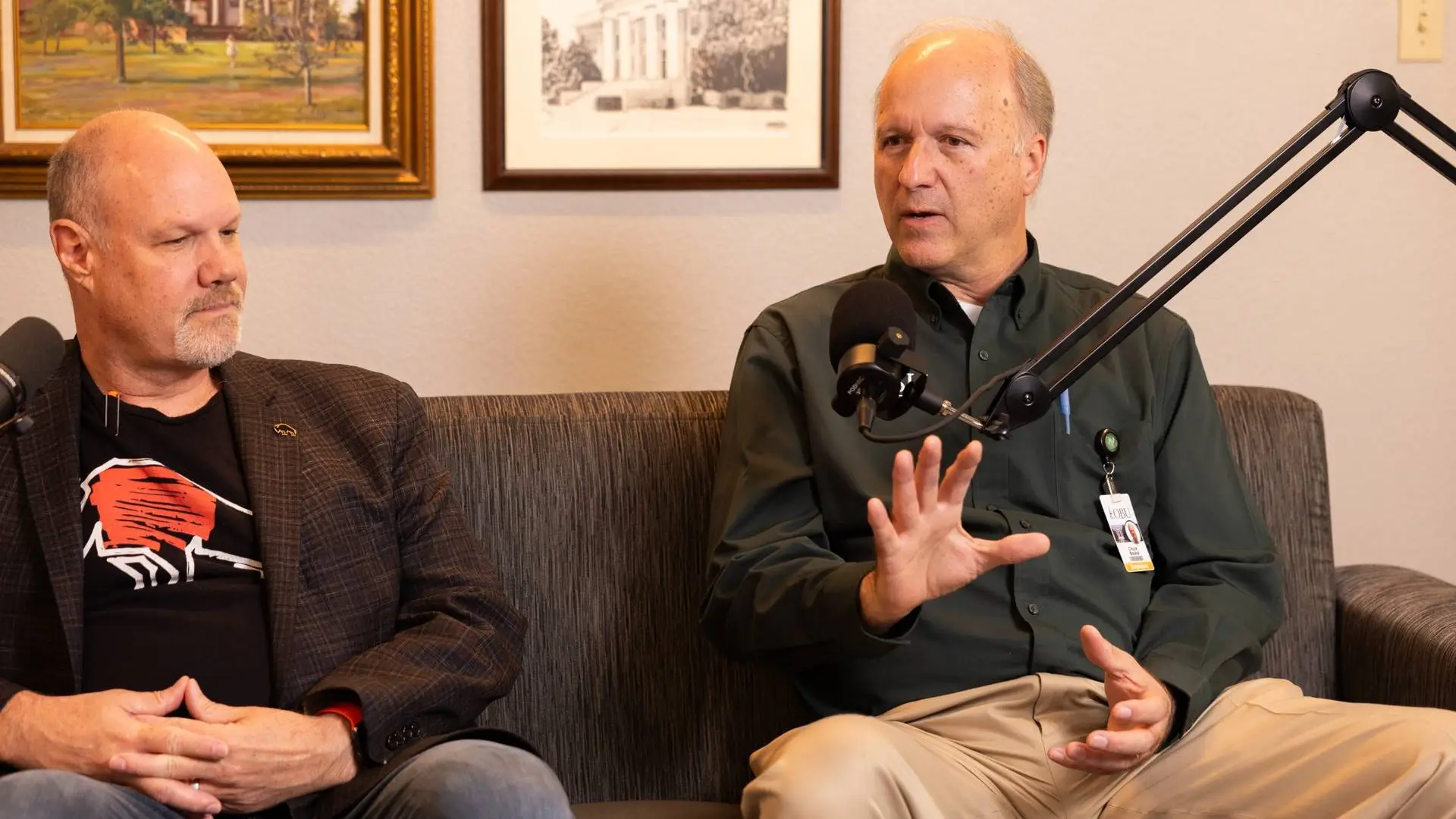
During a recent episode of the university’s “All of Life” podcast, Dr. Chuck Baukal, OBU engineering program director and associate professor, sat down with industry partner Thomas Hill III, CEO of Kimray, to discuss how students are best equipped for modern engineering careers. The conversation underscored OBU’s commitment to combining technical excellence with a faith-driven mission to glorify God through service and innovation.
Baukal, a seasoned educator with decades of experience in thermal sciences, and Hill, a third-generation leader at Kimray, are working together to reimagine how engineering education can bridge academic learning with practical application. Their shared vision focuses on preparing students for real-world challenges while remaining rooted in Christian principles.
The podcast, hosted by Niccole Hall, OBU regional director of advancement, covered the personal journeys of both Baukal and Hill, the evolving landscape of engineering, and OBU’s distinctive approach. For them, engineering is more than just a career; it’s a calling to solve problems and serve others.
“Engineering education has to be different,” Baukal said. “This was a chance for me to stop complaining about what I think is wrong with how we prepare engineers in the U.S. and to start doing things differently.”
With 11 patents and 17 authored books to his name, Baukal emphasizes that engineering education must equip students with problem-solving skills while grounding them in ethical decision-making.
Hill’s company, Kimray, is a leading manufacturer of oil and gas control equipment. As a seasoned industry professional who knows well the challenges engineers face, Hill credits his most impactful engineering class to a practicing engineer who introduced real-world challenges into the classroom.
“That class shaped my understanding of what engineering is: applying what you’ve learned to make something better,” Hill said. “It’s not enough to know the science and math. An engineer with integrity, humility and a commitment to serve others is far more valuable to a company and to the world.”
OBU’s engineering program embodies this philosophy by combining hands-on learning with robust industry partnerships. Through internships, mentorships and collaborative projects, students gain the experience necessary to succeed in a competitive job market while remaining anchored in their faith.
Launched in 2023, the engineering program is already making waves, exceeding expectations and reshaping the future for engineering students. Baukal highlighted that the program’s focus on hands-on learning and personalized instruction sets it apart from larger institutions.
“OBU’s program is different from the start,” Baukal said. “We focus on creating a learning environment where students aren’t just another face in the crowd. Here, your professor knows who you are – and that makes a world of difference.”
That personal connection and tailored instruction are key elements in OBU’s approach. He pointed out that at many larger universities, introductory courses are often taught by graduate teaching assistants with limited professional experience. In contrast, OBU ensures students have direct access to experienced faculty from day one.
Small class sizes provide another advantage, allowing students to master essential concepts in math, physics and foundational sciences. Hill stressed the importance of deeply understanding these basics, noting that engineers who internalize core principles are better equipped to tackle complex challenges.
“If you don’t have those basics mastered, you’re going to struggle later,” he said. “A good engineer doesn’t just pass through a math class – they internalize it. It becomes second nature.”
Internships play a pivotal role in OBU’s program, bridging the gap between theory and practice. Inspired by the German model, where students work alongside industry professionals throughout their studies, OBU aims to integrate hands-on experience into the curriculum.
Kimray, a key partner, offers meaningful internship opportunities where students take on real responsibilities and contribute to tangible projects. “We expect our interns to do real work,” Hill explained. “They’re responsible for a work product. Of course, they’re supervised, but they’re not just shadowing – they’re contributing.”
Baukal emphasized that internships not only build technical skills but also help students identify their career interests. “Internships let students test out different career paths,” he said. “They might love engineering but realize they’re more suited for design than manufacturing. Or they might discover a specific industry they’re passionate about, like aerospace or oil and gas.”
Industry support and donor contributions are vital in sustaining and expanding the program. Alumni and corporate partners have played an instrumental role in securing state-of-the-art resources, mentoring opportunities and scholarships. Their generosity is shaping OBU’s engineering program into a nationally recognized leader.
Looking ahead, Baukal is spearheading efforts to achieve ABET accreditation, a critical milestone that validates the program’s quality and rigor. Applying for ABET accreditation requires having program graduates first.
“Our first graduates will finish in a couple of years, and we’ll start the process then,” Baukal said. “It’s a rigorous process, but I’ve been an ABET evaluator for over a decade, so I know what we need to do.”
As the program grows, so does the transformation of Thurmond Hall into a cutting-edge engineering hub. The first phase of renovations is complete, with further construction beginning this semester. These upgrades will include modern classrooms, labs, project spaces and dedicated study areas, providing students with an environment that fosters innovation and collaboration.
Two standout features of the new facility are already generating excitement: a 10-foot-long military-grade drone donated by Kratos Defense and a 3D-printed bison, symbolizing OBU’s spirit and tradition. Additionally, a state-of-the-art wind tunnel, set to arrive this spring, will enhance hands-on learning opportunities, particularly for students pursuing aerospace-related projects.
With all these developments, OBU’s engineering program is rapidly gaining recognition in Oklahoma and beyond. The combination of small classes, hands-on experiences and robust industry partnerships is preparing students not only to succeed but to lead in their fields.
For Hill, it all comes down to giving students the best possible start. “OBU’s program is special because it puts students first,” he said. “It’s about more than teaching skills – it’s about helping young people discover their potential and make an impact in the world.”
As Thurmond Hall continues to take shape, plans for new engineering programs are in the works, and the network of industry partners continues to grow, the future is bright for OBU engineering students.