
OBU Celebrates Winter Commencement; Loughridge Delivers Address
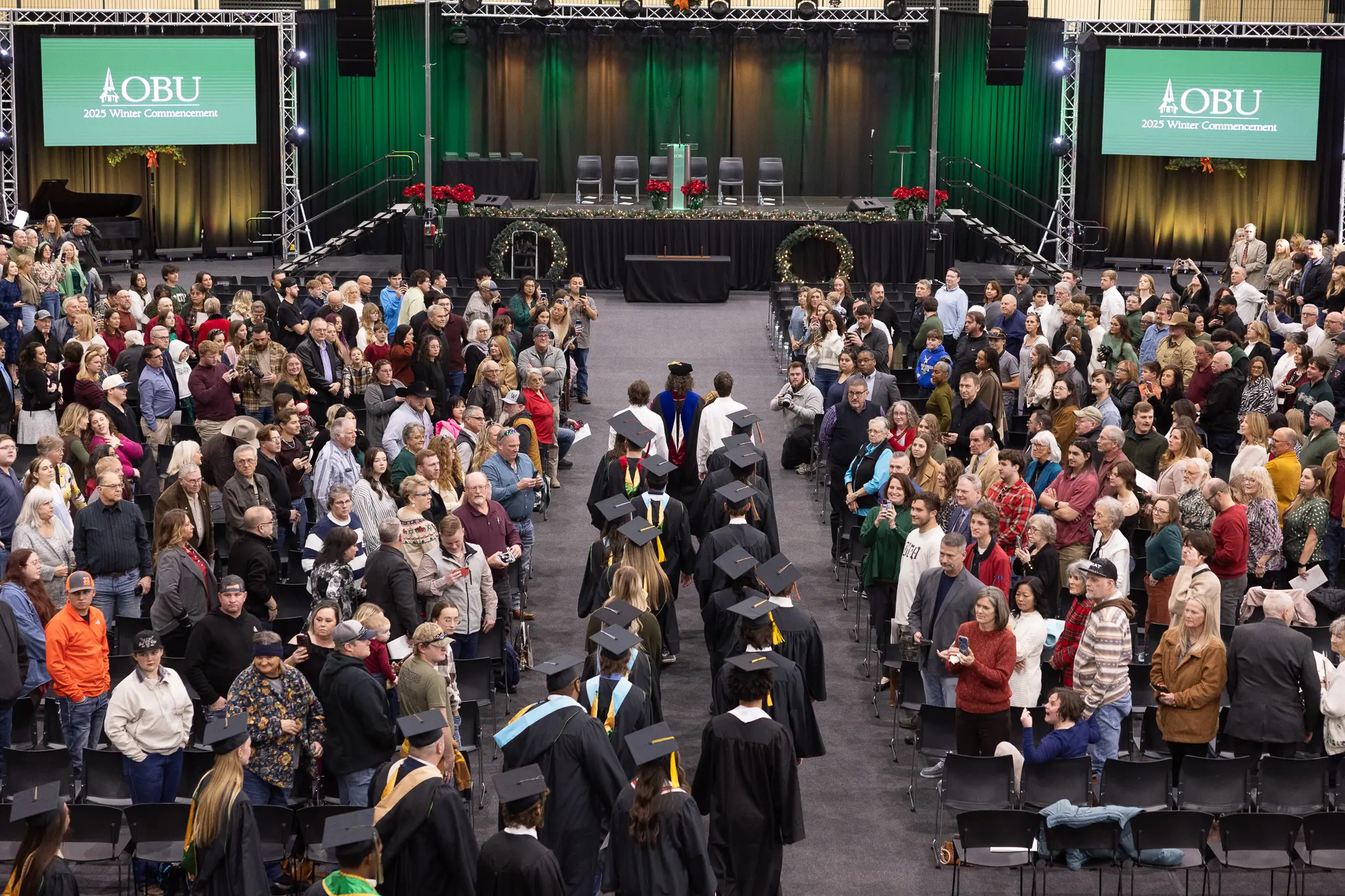
OBU conferred degrees during Winter Commencement on Saturday, Dec. 13, 2025, at 2 p.m. in the Recreation and Wellness Center at OBU. The ceremony marked the first OBU commencement held on campus since the April 2023 EF2 tornado.

Jerome Loughridge delivered the commencement address at OBU’s 2025 Winter Commencement. Loughridge is the inaugural executive director of the Aspen-Kern Program on Leadership and Character in Higher Education.
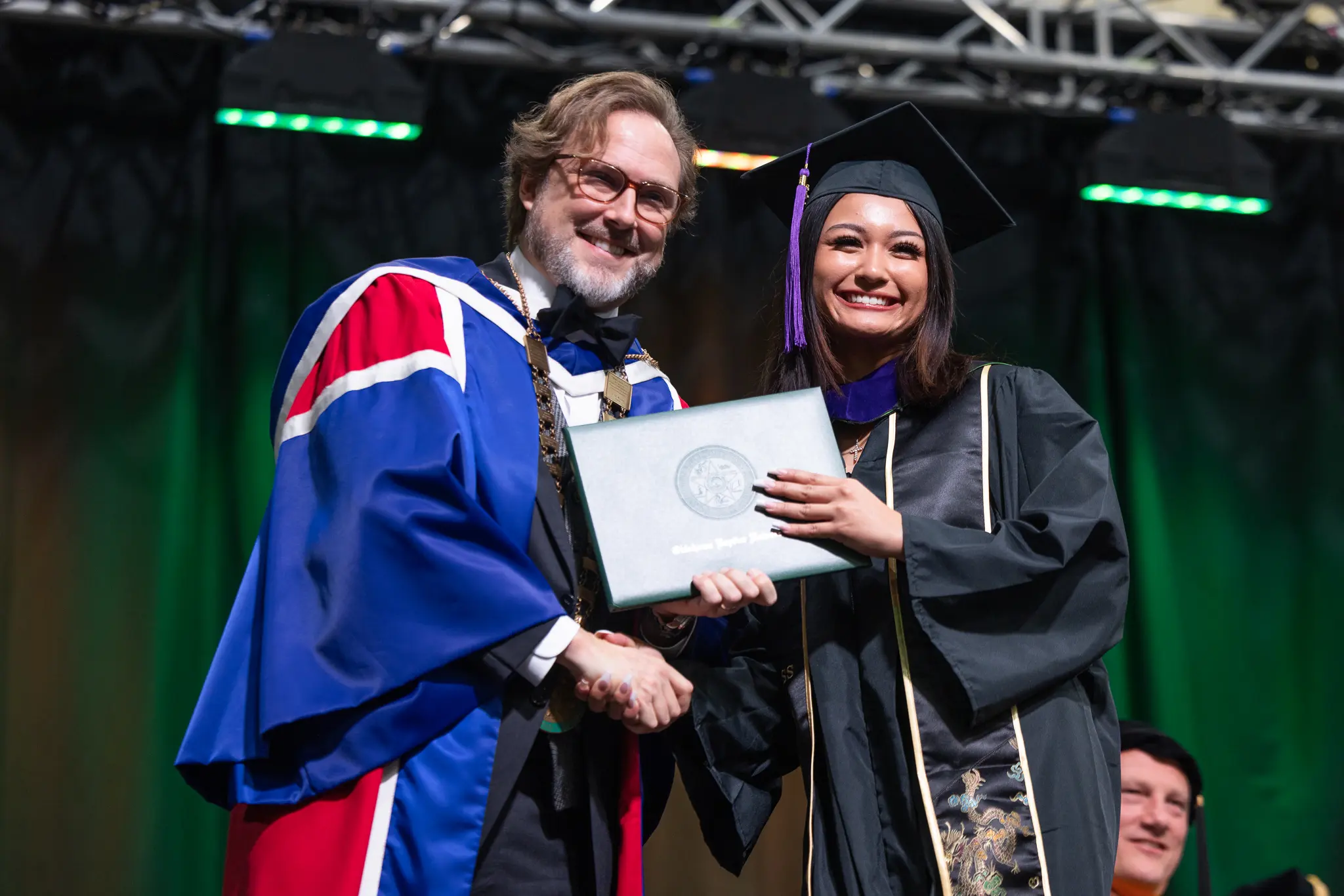
OBU conferred degrees upon graduates during Winter Commencement on Saturday.
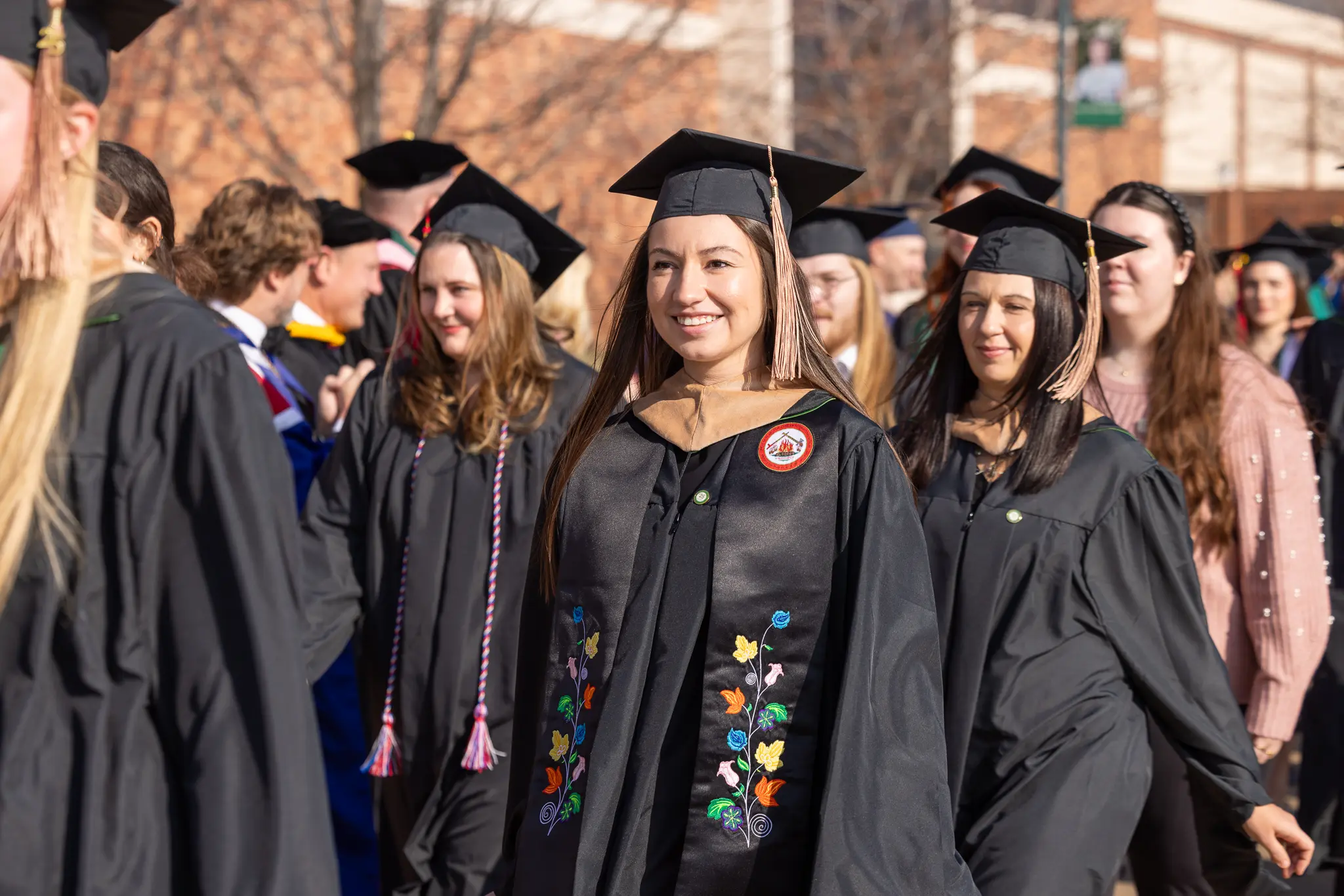
“The Walk,” a longstanding OBU tradition, was held immediately before commencement. The symbolic walk mirrors the one taken by new students during Welcome Week, representing their journey through OBU and their transition into life beyond Bison Hill.
OBU conferred degrees during Winter Commencement on Dec. 13, 2025, at 2 p.m. in the Recreation and Wellness Center (RAWC) on OBU’s campus in Shawnee. The ceremony marked the first OBU commencement held on campus since the April 2023 EF2 tornado.
The service opened with “Schmücke dich, o liebe Seele” by Brahms, performed by Dr. Mark Franklin, Burton H. Patterson Professor of Music and assistant professor of music. Franklin also presented the processional, “Komm, Gott Schöpfer, Heiliger Geist” by Bach/Busoni.
Following the invocation by Dr. Rafael Bello, Ida Elizabeth and J.W. Hollums Chair of Bible and assistant professor of religious studies, attendees were welcomed by OBU President Dr. Heath A. Thomas, with greetings delivered by Dr. Todd Fisher, executive director-treasurer of Oklahoma Baptists.
The congregation joined in singing “Joy to the World,” led by Dr. Joshua Chism, associate professor of music, choral and vocal, accompanied by Franklin on piano. Dr. Amadi Amaitsa, assistant professor of history, offered a reading from Isaiah 9:1–7.
Loughridge Delivers Commencement Address
After an introduction by Thomas, Jerome Loughridge delivered the commencement address. Loughridge is the inaugural executive director of the Aspen-Kern Program on Leadership and Character in Higher Education, a national Aspen Institute initiative supporting new college presidents. He is a native Oklahoman with leadership experience in higher education and the energy sector.
A former White House Fellow and Oklahoma secretary of health and mental health, Loughridge is a Baylor graduate and Truman Scholar who studied at Harvard. He is currently completing a Master of Studies at the University of Oxford.
Loughridge opened his OBU commencement address by celebrating the graduates’ accomplishment, telling them they were leaving an “esteemed liberal arts university” and stepping into a “timeless tradition of education that animated the likes of our Founding Fathers and has influenced the greatest thinkers of the West for untold generations.”
He affirmed the enduring value of their education, noting that a liberal arts foundation prepares graduates for a lifetime, not just a single role.
“It may in fact be most acutely felt by those of us who enjoyed a liberal arts education,” he said, emphasizing the breadth of understanding it cultivates.
Reflecting on his own career across business, higher education, government and nonprofit service, he said that when facing widely varied challenges, “I fell back on the character that had been developed, in large part, through the hard work of liberal learning.”
He credited his “Christian liberal arts education – the same type you received here at OBU – with putting me on a path toward lifelong intellectual curiosity, a commitment to moral inquiry and the habituation of practices and disciplines that ultimately shaped my character.”
Loughridge reminded graduates that their deepest identities transcend career achievements.
“I am first a follower of Christ, a husband, a father of two young men, a son, a teacher, a citizen,” he said.
He shared the wisdom he gained abroad, where he learned never to define others by their jobs, recognizing the dignity of every person.
He highlighted the unique power of a Christian liberal arts education, where “Athens meets Jerusalem,” and drew from OBU Professor Benjamin Myers’ words: “We study the history and literature of Western civilization in order to see these transcendentals at play… the True, the Good and the Beautiful.”
Loughridge encouraged graduates to bring these virtues into public life, where disciplined study and moral courage can elevate dialogue.
He concluded with C.S. Lewis’s reminder that “There are no ordinary people. You have never talked to a mere mortal,” telling graduates, “I can’t wait to see how you impact this world of no-mere-mortals. God bless you.”
Presentation of Degrees
Loughridge’s address was followed by special music, “Like a River Glorious” by Wyrtzen, performed by Elizabeth Houser, a Bachelor of Music in Composition graduate.
The undergraduate class was presented by Spencer Barnhill, president of the OBU Student Government Association and Dr. Larinee Dennis, co-provost and chief academic officer and professor of education.
The presentation of bachelor’s degree candidates was made by Dennis, who also presented Summa Cum Laude candidates.
The graduate class was presented by Lauren Jardot, a Master of Arts in teaching graduate, along with Dennis. Thomas conferred both undergraduate and graduate degrees.
After the conferral of degrees, Lea Ann Quirk, director of the OBU Alumni Association, inducted the graduates into the OBU Alumni Association.
Final Charge
In presenting the final charge to the graduates, Thomas charged Winter 2025 graduates to resist grand notions of changing the world and instead embrace faithful living in the places God gives them.
Commending the class for perseverance, Thomas asked graduates to consider their future, posing the questions, “What shall you do? Who shall you be? What next?”
Thomas dismissed sweeping exhortations as insufficient.
He said, “If I were an inspiring speaker, I might say something like, ‘Take your gifts and talents and change the world!’ Inspiring, but probably unhelpful.” Instead, he grounded his message in the life of his grandfather, Calvin Kermit Houser, whom he called “my hero.”
Houser, the child of German immigrants, lived nearly his entire life on family farmland in the Smoky Mountains near Knoxville, Tennessee. The Houser family built barns, homes and a dairy operation by hand and Thomas emphasized the constancy of that life, saying his grandfather “lived in the house of his birth … until he was 99½.”
From that life, Thomas said, he learned enduring lessons. Recalling early farm mornings, he told graduates, “I learned from him the truth that there is no replacement for hard work, especially the hard work of the farm.”
Speaking of Houser’s Navy service in World War II, Thomas said, “I learned from him that service to something greater than myself is honorable and needed.”
From years of postwar work and gardening, Thomas said his grandfather taught him “the virtue of providing food for his family and the effort it takes to make that a reality.”
Faith and community were central to Houser’s example. Thomas recalled worshiping with him and said, “He taught me about the beauty of faith, the love of Christ and the truth that there is no substitute for living well before God.”
He also remembered his grandfather’s care for neighbors and family, adding, “I learned from him we are part of a local community, in which each of us plays a role.”
From those lessons, Thomas urged graduates to focus on faithfulness rather than prominence.
“I cannot tell you to go change your world,” he said. “What I can do is encourage you to cultivate the little—seemingly insignificant—plot of life God has provided for you.”
Emphasizing the importance of everyday obedience, he reminded them, “God uses the little things to make a difference.”
Citing Voltaire’s Candide, Thomas underscored the theme, quoting, “I also know that we must cultivate our garden.”
He concluded, “Shaping the future is not about changing the world. It is about each of us being faithful and responsible cultivators of the gardens in which God has placed us.”
Following the president’s charge, “The Hymn to the Alma Mater” by Angell and Tisinger was performed by a tenor ensemble featuring Sam Oursler, a Bachelor of Music Education student; Sergio Vazquez, a Bachelor of Musical Arts student; Payton Carter, a Bachelor of Music in Composition student; and Nate Winn, a Bachelor of Arts in Worship student. Franklin accompanied the ensemble on piano. Chism closed the ceremony with the benediction.
Watch the video of OBU's December graduation ceremony on YouTube.